
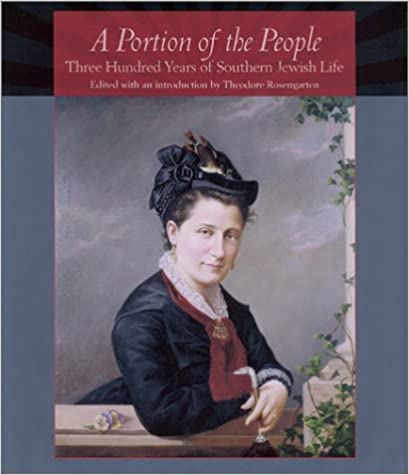
Size: 9.25 x 10.75
Pages: 288
Illustrations: 74 b&w halftones, 86 color halftones
Cultural Studies & Sociology
hardcover
Books
South Carolina History & Culture
Jewish Studies
A Portion of the People
Three Hundred Years of Southern Jewish Life
edited by Theodore Rosengarten and Dale Rosengarten
Ebook
Published:
The inclusion of this book in the Open Carolina collection is made possible by the generous funding of
"As a model study of a pivotal city and its surrounding region, this masterpiece eloquently traces Jewish engagements with freedom and the wider community. Emerging from a landmark exhibition, A Portion o fhte People stands as a testament to the power of collaborative scholarship to produce work of lasting significance."—Michael R. Cohen, Tulane University, author of Cotton Capitalists
"A Portion of the People beauitfully captures the vitality ad complexity of three centuries of Jewish life in South Carolina. Through artificast, illustraions, and elegant essays we are introduced to a stunning cast of Jewish CArolinians. Filled with empathy and life, this book is a magnificent achievement."—Adam Mendelsohn, University of Cape Town, author of Jewish Soldiers in the Civil War
"An indispensable guide to the Jewish history South Carolina. Drawing on the rich archives of the state's Jewish community. Theodore and Dale Rosengarten guide their readers through 300 years of history. Their emphasis on the materials culture produced by a wide range of South Carolina Jews is particularly innovatve."—Shari Rabin, Oberlin College, author of The Jewish South
"Until 1830 Charleston was the captial of American Jewry; Christians in South Carolina elected the first professing Jew to office; Reform Judaism first came to the United States in the Palmetto State. These and many other fascinating facts are explored in this handsome treasure troce, a must-read for anybdy interested in the complex relationship of Jews and the South. Theodore and Dale Rosengarten have lovingly and movingly compiled a masterpiece, a delight for both the mind and the eye."—Philip Morgan, Harry C. Black Professor Emeritus of History, Johns Hopkins University