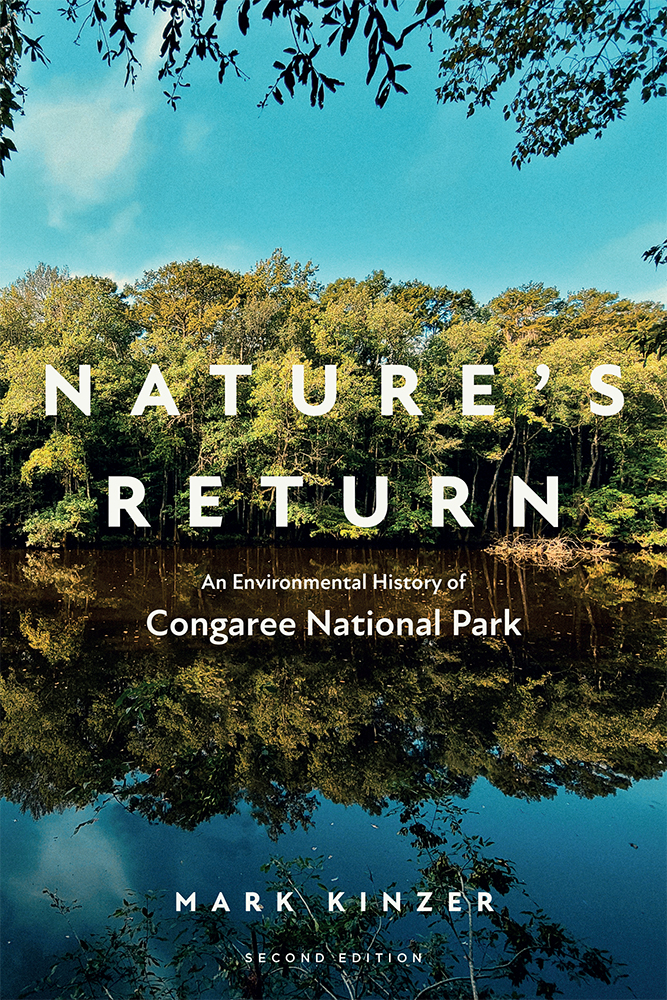
A remarkable history of human disturbance and nature's return
Congaree National Park is a forest of vast flats and winding sloughs, where champion trees rise high above one of the nation's largest surviving expanses of old-growth bottomland hardwood forests. To modern visitors, the landscape can seem ancient and untouched. Its history shows something far different.
Revised and expanded with updated scholarship, new maps, and enhanced illustrations, this second edition of Nature's Return shows how people have used the land differently at different times, and the landscape has changed in response. Congaree's history reveals something larger about southern floodplain forests. After the cessation of logging and other forms of exploitation nature returns, but the past does not simply disappear.
Mark Kinzer uncovers the long history of human activity now obscured by the park's old-growth and maturing forests. For thousands of years, people have modified the Congaree floodplain to meet their needs. Native Americans used fire and cleared land for agriculture. Later inhabitants grazed cattle, established plantations, diked and drained fields, and cut timber. By the early twentieth century, farming, burning, grazing, and logging had left their marks across much of the floodplain.
Drawing on archaeological and ecological studies, tree-ring analyses, property and census records, narratives by formerly enslaved people, historic newspapers, maps, and other sources, Kinzer traces the interplay of human disturbance and forest dynamics. The evidence he uncovers in the swampy muck as well as in archival records challenges simple notions of a pristine wilderness. The ecosystem of Congaree is extraordinary and vital precisely because of this complicated history of human-nature interaction.
Mark Kinzer worked for more than twenty years as a planner and wilderness manager with the National Park Service. He holds a JD from the University of Georgia School of Law and, prior to his career with the Park Service, worked as an environmental lawyer. Kinzer is also coeditor of Wood Basket of the World. He lives in Greenville, South Carolina.